‘The Odyssey’ Review: Christopher Nolan Conquers the Ancient World With a Monumental Masterpiece
Review by Kevin Ward
Courtesy of Universal.
Christopher Nolan has spent his career making films about men destroyed by their own brilliance. Leonard Shelby loses himself inside his memories. Bruce Wayne turns trauma into mythology. Robert Oppenheimer creates a weapon that permanently reshapes the world. In ‘The Odyssey,’ Nolan travels back thousands of years to find the original tormented sinner-hero and discovers that Odysseus may have been his perfect protagonist the entire time.
Nolan grabs the ancient poem by the throat, rearranges its mythology and transforms it into a colossal story of war, guilt, memory and spiritual displacement. The result is a staggering three-hour epic: a brutal adventure film, a supernatural nightmare and a deeply affecting portrait of a soldier who may return home physically, but can never truly escape the battlefield.
Matt Damon plays Odysseus, the military commander from Ithaca whose weathered face carries the exhaustion of a man who has spent too long pretending to believe in his own cause. Before leaving for Troy, he tells his wife Penelope, played with fierce restraint by Anne Hathaway, that she should remarry if he fails to return. He also admits that the supposed reason for the war (the flight of Helen with the Trojan prince Paris) is little more than political theatre. Beneath the songs of honour and destiny lies a far more ordinary motive: power, trade and control.
Nolan’s Bronze Age is not the polished world of pristine marble columns and spotless white robes. It is a civilisation already beginning to rot. Its structures are severe, its coastlines hostile and its rulers concealed behind masks, armour and manufactured legends. Benny Safdie’s Agamemnon, hidden beneath an intimidating helmet, seems less like a heroic king than the representative of a war machine that has forgotten why it is fighting.
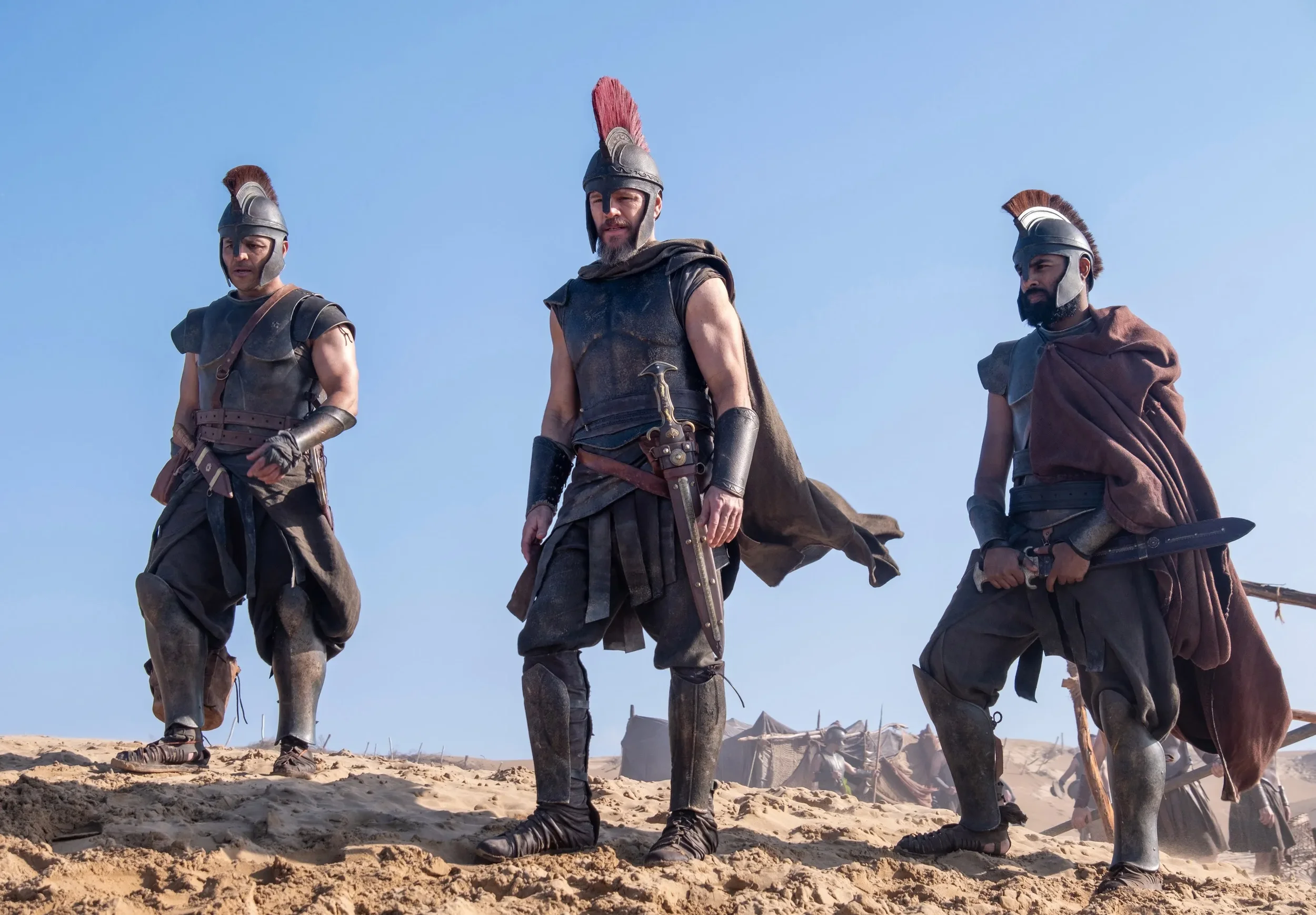
Odysseus becomes both witness to and architect of that collapse. His Trojan horse is not presented as a clever historical footnote, but as the ancient equivalent of a weapon of mass destruction: an invention so effective that it changes the moral character of warfare. Half-buried in the sand, the enormous wooden creature resembles a relic from a dead civilisation, looming over Troy with the apocalyptic themes.
Inside, Odysseus and his men are packed together in suffocating darkness as Ludwig Göransson’s drums accelerate like a collective heartbeat. Nolan makes the legendary victory feel less triumphant than obscene. The Greeks are not saviours. They are invaders waiting inside a wooden idol, preparing to slaughter a city that has unknowingly dragged its own destruction through the gates.
The deception also requires Odysseus to betray his cousin Sinon, played by Elliot Page, turning military strategy into a blood sacrifice that will haunt him long after Troy has fallen. Nolan understands that the most damaging consequences of war rarely arrive during the battle itself. They surface later in silence, memory, guilt and the inability to continue with an ordinary life.
‘The Odyssey’ becomes an epic about the invisible journey home: the years, sometimes decades, it can take for soldiers to return emotionally and spiritually from violence. Odysseus survives the war, but survival offers no peace. Every island, creature and goddess he encounters feels like another manifestation of his psychological collapse.
His voyage becomes a procession of hunger, death and supernatural terror. There is the Cyclops, a grotesque practical creation whose warped face looks as though it has been crushed beneath the foot of an even larger monster. There are the Laestrygonians, the Sirens and the many-headed Scylla, hidden in shadow and captured with enough physical weight to make them feel less like visual effects than creatures genuinely lurking beyond the frame.
Samantha Morton is extraordinary as Circe, reimagined through a horrifying piece of body horror. No spoilers here, but let’s just say it’s disgusting, frightening and darkly poetic; one of the film’s most unforgettable sequences.
Charlize Theron’s Calypso is given less to work with, largely reduced to observing and medicating Odysseus during his prolonged captivity. Nolan’s adaptation is notably chaste, stripping away much of the hero’s erotic hypocrisy and softening the more selfish aspects of Homer’s warrior. This Odysseus remains arrogant, stubborn and sacrilegious, but Damon’s inherent decency makes him more wounded than wicked.
It is one of the film’s few compromises. The original Odysseus is a liar, seducer, egotist and genius who demands loyalty while constantly violating it himself. Nolan occasionally seems hesitant to let his hero become completely unpleasant. Yet Damon still gives a tremendous performance, gradually turning his familiar, almost boyish face into a mask of exhaustion. His Odysseus is a man terrified that home will force him to confront what the journey has allowed him to avoid.
Meanwhile, Ithaca has become another kind of battlefield. With Odysseus presumed dead, Penelope’s palace is occupied by opportunistic suitors who consume her food, abuse her servants and circle her kingdom like vultures. Penelope delays choosing a new husband while attempting to prevent a violent power struggle, trapped within a permanent celebration that has curdled into a bacchanal of greed.
Robert Pattinson is deliciously vile as Antinous, the sleekest and most dangerous of the suitors. He courts Penelope with the smug confidence of a reality-show contestant convinced that the final rose already belongs to him. Behind the charm is cruelty, particularly toward Odysseus’s blind servant Eumaeus, played with enormous warmth by John Leguizamo.
Tom Holland brings a wounded uncertainty to Telemachus, Odysseus’s son, who has grown into adulthood beneath the shadow of a father he barely remembers. He embarks upon his own journey to determine whether Odysseus is alive, dead or simply another legend that has abandoned him. Holland plays him not as an emerging action hero, but as a young man desperate to inherit an identity that may never have existed.
Zendaya’s Athena hovers at the edge of the film like a sorrowful apparition. Nolan radically reduces the direct intervention of the gods. Poseidon exists largely through rumour and violent water; Zeus is suggested through thunder; Athena watches with an expression that could indicate divine judgment, human disappointment or nothing supernatural at all.
The ambiguity is deliberate. Nolan balances religion on the point of a spear, never confirming whether the gods are controlling these lives or whether men have created the gods to avoid accepting responsibility for their own destruction. When Telemachus searches for divinity inside the people he meets, Odysseus warns him not to look for gods in men because disappointment is inevitable. The line contains the film’s entire worldview: civilisation collapses not because the gods abandon humanity, but because humanity repeatedly abandons itself.
Visually, ‘The Odyssey’ is overwhelming. Hoyte van Hoytema’s IMAX cinematography turns coastlines into vast landscapes of isolation. The sea avoids the expected sparkling Mediterranean blue, appearing instead as an indifferent mass of grey, black and metallic green. Ships groan against violent waves. Torch-lit interiors burn in stark orange against impenetrable darkness, evoking the limited colours of ancient Greek pottery.
Van Hoytema’s camera rocks with the ships, runs alongside terrified soldiers and peers into darkness where monsters may or may not be waiting. The enormous scale never becomes hollow spectacle because every landscape reinforces Odysseus’s loneliness. The world is vast, yet there is nowhere he can escape himself.
Göransson’s score is equally ferocious. Drums pound through the assault on Troy with escalating panic, while woodwinds and distant voices occasionally emerge like fragments of the oldest song still remembered by humankind. Some of the more contemporary thriller music used during the Ithaca sequences feels overly aggressive, as though the film fears silence might allow the audience to escape. Yet when score, image and action align, the effect is almost primal.
Nolan occasionally buries emotional revelations beneath his familiar love of withholding information. The film’s opening is dense with exposition, and certain motivations are saved for late dramatic reveals when the Greeks themselves would have presented them directly and allowed inevitability to create the tension. There are also moments when the dialogue swings with the blunt force of a battle axe.
But these imperfections seem almost insignificant beside the film’s scale, seriousness and sheer force of imagination. Nolan has not simply adapted ‘The Odyssey,’ but has used it to construct a myth about the collapse of empires, the seduction of military genius and the generational trauma that remains after nations have forgotten what their wars were supposed to achieve.
Colossal, unnerving and frequently breathtaking, ‘The Odyssey’ is blockbuster filmmaking at its most ambitious: a thunderous spectacle with the soul of a tragedy. Nolan has taken one of civilisation’s oldest stories and made it feel violently, painfully alive.
Our score (out of 5 stars): ★★★★★