‘Supergirl’ Review: Milly Alcock Brings Spark, But DC’s Punk-Rock Heroine Gets Lost in the Wasteland
Review by Kevin Ward
Courtesy of DC Studios.
There is a moment in last year’s ‘Superman’ reboot where Clark Kent earnestly describes Superman’s goodness as “punk rock,” a line so painfully self-conscious it practically arrives wearing a studded leather jacket from the mall. ‘Supergirl,’ the second major outing from James Gunn’s new DC Studios, seems to have taken that phrase not as a warning but as a full creative manifesto, forming a film that does not simply want to be rebellious, messy, abrasive, and cool… it wants you to notice how rebellious, messy, abrasive, and cool it thinks it is.
Unfortunately, the harder ‘Supergirl’ tries to sneer at traditional superhero earnestness, the more artificial it feels.
Milly Alcock stars as Kara Zor-El, Superman’s cousin, reimagined here not as the radiant, hopeful figure of comic-book legacy but as a hungover intergalactic wanderer in oversized sunglasses and a Blondie T-shirt. She drifts through wasteland planets (that all look the same, leading to zero creative freshness), dives into junkyard bars, gets into fights, and behaves less like a superhero than a cosmic burnout avoiding her responsibilities. On paper, that is not a terrible idea. A traumatized Kryptonian survivor who rejects the symbolic burden of heroism could have made for a fascinating counterpoint to Superman’s moral clarity. The problem is that ‘Supergirl’ mistakes attitude and obnoxiousness for relatability.
Kara is wounded, yes, but the film rarely lets that pain become dramatically interesting. Her backstory (another doomed Krypton tragedy, this time rendered with an extra layer of CGI misery) should give her a haunted emotional core. Instead, it feels like a mandatory lore packet dressed up as trauma. Alcock has presence, and there are flashes of vulnerability beneath the character’s dishevelled bravado, but the screenplay gives her too little modulation. Kara begins the film bored, angry, and self-destructive, and for long stretches she remains parked in exactly that register.
The plot is both simple and strangely exhausting. Kara crosses paths with Ruthye Marye Knoll, played by Eve Ridley, a young alien girl seeking revenge against Krem of the Yellow Hills after he murders her family. Krem, a human trafficker and space pirate played by Matthias Schoenaerts, also poisons Krypto the Superdog, forcing Kara into a race against time to find the antidote. So there it is: avenge the family, save the dog, defeat the villain. As superhero motivations go, these are clean enough. Yet somehow ‘Supergirl’ turns them into a flat, episodic slog.
The film deserves some credit for not drowning itself in the tangled franchise homework that has plagued so many DC movies. Compared with last year’s overstuffed ‘Superman,’ this is at least a more direct adventure. But clarity is not the same thing as momentum. Scene after scene arrives with noise, creatures, combat, quips, and scorched-earth production design, yet very little accumulates emotionally. The movie is busy without being complex, loud without being thrilling, and snarky without being especially funny.
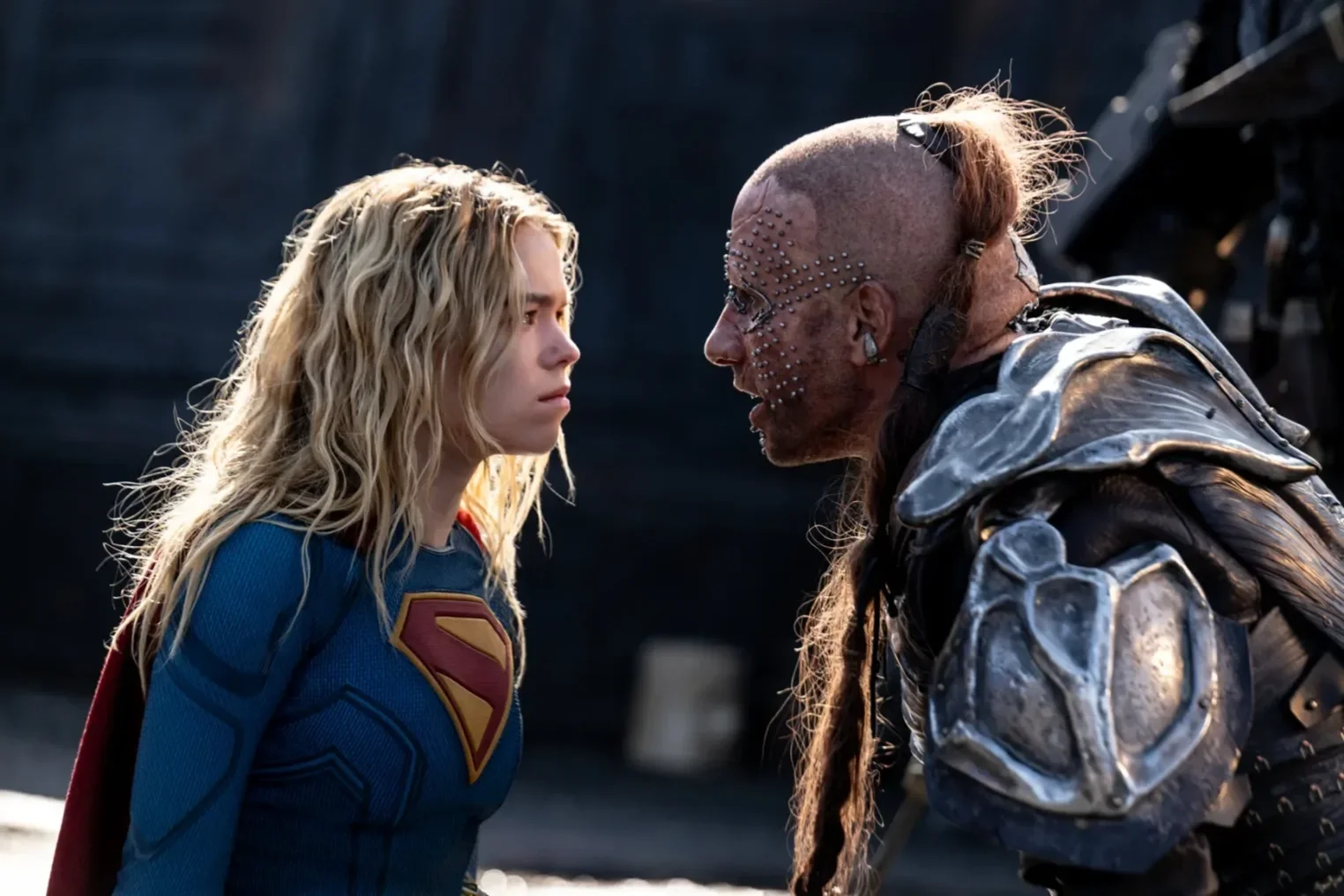
Krem is a particular disappointment. Schoenaerts gives the role a physical menace, but the character is less a villain than a collection of second-hand dystopian signifiers: shaved head, strange accent, grotesque styling, pirate cruelty, and a vague whiff of ‘Mad Max’ cosplay. We are told he is terrifyingly powerful, but he never becomes psychologically compelling. A villain like this does not need subtlety, exactly, but he does need presence. Krem has brutality; he lacks magnetism.
Ridley’s Ruthye fares somewhat better, if only because the character’s grief gives the film a clearer emotional line. Still, she is written in a mode of relentless grim determination, repeatedly announcing her desire for vengeance with the solemnity of someone trapped in a prestige fantasy drama. The partnership between Ruthye and Kara should be the film’s moral engine: a grieving child pushing a disillusioned hero back toward purpose. Occasionally, that dynamic flickers to life. Too often, though, it is buried beneath creature-bar clutter and posturing.
It also doesn’t help that characters tell you how you should feel, rather than having real merit that grounds the film in authentic emotion.
Visually, ‘Supergirl’ is a strange mixture of ambition and fatigue. Director Craig Gillespie, who brought sharp tonal intelligence to ‘I, Tonya’ and ‘Cruella,’ seems trapped inside the machinery of a franchise film that has already decided what rebellion is supposed to look like. There are dusty planets, grotesque aliens, neon-lit dens of scum and villainy, and enough cantina-style weirdos to make the movie feel like it is rummaging through half a century of space-opera leftovers. The creatures may be technically elaborate, but they rarely feel wondrous. After a while, the film’s universe begins to resemble a very expensive costume party where everyone came dressed as “edgy.”
Jason Momoa briefly jolts the movie awake as Lobo, a cigar-chomping bounty hunter biker who looks like he wandered in from a heavy-metal album cover and refused to leave. His scenes have the unruly comic energy the rest of the film keeps straining to manufacture. David Corenswet’s Superman also appears in a small, warmer cameo, and his presence unintentionally highlights what ‘Supergirl’ is missing: a coherent moral center. The film wants Kara to stand in contrast to Superman’s goodness, but it never fully articulates what she represents instead. Cynicism? Truth? Rage? Freedom? Trauma? The answer changes depending on which scene is currently trying hardest to sound profound.
Let’s not even talk about how horrid the CGI and editing is… moving on!
That is the larger problem with ‘Supergirl’: it is a superhero movie deeply suspicious of classic superheroism, yet not imaginative enough to replace it with something richer. Its idea of subversion is largely cosmetic. Put the heroine in a band shirt. Let the dog urinate on a Superman headline. Trade primary colors for desert grime. Swap noble speeches for bitter one-liners. But beneath all that performative rebellion sits a surprisingly conventional revenge-and-rescue quest, told with less emotional force than its premise deserves.
There are moments when the film suggests a better version of itself. Alcock has the makings of a compelling Kara, especially when the movie stops trying to prove how cool she is and allows her sadness to surface. The central idea — that heroism can emerge not from innocence but from damage — is strong. Even the much-discussed “Supergirl” title carries an interesting tension, pointing toward the franchise’s uneasy relationship with female maturity, mythic identity, and marketable branding. But the film gestures at these ideas rather than developing them.
For a movie so determined to be punk, ‘Supergirl’ feels oddly committee-made. It has the leather jacket, the sneer, the playlist, and the anti-establishment pose. What it lacks is danger, surprise, and soul. Punk, after all, is not just an aesthetic. It is a pulse. This movie has the haircut, but not the heartbeat.
‘Supergirl’ does not completely crash and burn. It is clearer and occasionally livelier than some recent DC misfires, and Alcock may yet grow into the role if given a stronger script. But as her first true solo flight, this is less a bold reinvention than a noisy identity crisis. The film keeps insisting that Kara Zor-El is not Superman. Fair enough. The trouble is that by the end, we still have not figured out who she actually is either.
Our score: ★★☆☆☆