‘In the Grey’ Review: Guy Ritchie’s Slick, Shallow, and Strangely Irresistible Pulp Machine is a Blast
Courtesy of Black Bear Pictures / Toff Guy Films.
Guy Ritchie’s recent career has begun to resemble one of his own heist diagrams: overstuffed, overconfident, faintly absurd, and somehow still moving with enough velocity to outrun its own faults. ‘In the Grey,’ Ritchie’s latest exercise in bespoke mayhem, arrives with the suspicious aura of a film that has spent too long in the vault: shot in 2023, rescheduled, reshaped, and reportedly trimmed into something leaner, stranger, and more breathless. The result is not exactly elegant, and yet, undoubtedly an irresistible blast.
From ‘Snatch’ onward, Ritchie’s crime thrillers have treated character less as psychological depth than as surface grammar: watches, suits, weapons, accents, postures, and the ability to remain preternaturally calm while everything explodes. With ‘In the Grey,’ this tendency reaches a refinement. The people onscreen are not so much characters as expertly styled action-functions. They do not develop; they deploy.
The premise is pleasingly baroque. Rachel Wild, played with lacquered authority by Eiza González, is a debt-collection lawyer of apparently mythic competence. She is hired by a reptilian Manhattan asset manager, Bobby, played by Rosamund Pike with the sort of surgical froideur that suggests she could liquidate a pension fund before breakfast, to recover $1 billion from Salazar, an underworld kingpin played by Carlos Bardem. Salazar has retreated to a private island, naturally equipped with a private army, because in Ritchie’s universe wealth is never merely financial; it is architectural, militarized, and tastefully lit.
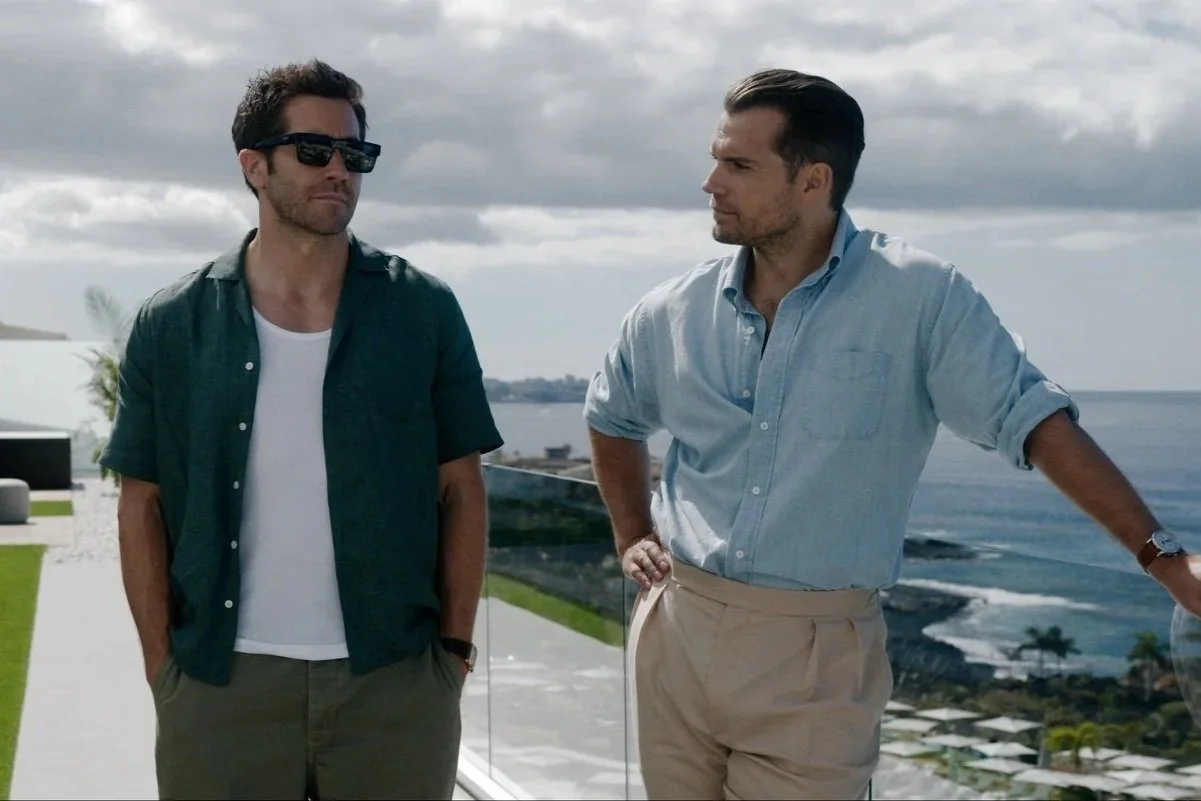
Rachel is joined by Sidney and Bronco, played by Henry Cavill and Jake Gyllenhaal, two mercenary specialists whose relationship is one of the film’s liveliest textures. Their dynamic hovers somewhere between fraternal banter, professional intimacy, and open homoerotic cosplay. Ritchie’s films have often flirted with queer subtext, sometimes clumsily, but here the joke is less mean-spirited than unusually affectionate. Cavill and Gyllenhaal seem to understand that they are playing men whose tactical competence is inseparable from their mutual adoration of gadgets, danger, and each other.
The plot, such as it is, involves plans within plans, escape routes, false moves, legal pressure, island logistics, cocktail preparation, and enough on-screen text to make the film occasionally feel like a luxury-brand PowerPoint presentation. Ritchie does not so much dramatize exposition as laminate it. Voiceovers explain motives. Labels identify phases. Lists appear over the action. At times, the film seems to be apologizing for its own density in real time, as though worried the audience might miss the elegant nonsense of the scheme.
Yet this chaos is also part of the pleasure. ‘In the Grey’ has the feel of a filmmaker enjoying the mechanics of a disposable object with entirely non-disposable craft. Ritchie’s sense of movement remains sharp. The best action sequence — a clean, muscular chase involving motorcycles, police cars, and crisp editing — reminds us that he can still stage chaos with unusual clarity, similar to the highs of his 2015 film ‘The Man from U.N.C.L.E.’ Unlike many contemporary action directors, he knows where people are in relation to one another, what the stakes of a movement are, and when to let rhythm do the work.
The film is undeniably overdesigned. Everyone looks too immaculate, even under fire. Yes, Superman (Cavill) is indeed in the flick, but both leads survive with superheroic convenience. The dialogue about asset management and global financial leverage occasionally sounds as if it were imported from a hedge-fund fever dream. Fisher Stevens, as Salazar’s lawyer, is left waiting for sharper material that never quite arrives. The final stretch bears the marks of compression, with the ending arriving first satisfyingly and then too abruptly, as if someone in the editing room suddenly remembered the film had a release date and runtime to manage.
What separates ‘In the Grey’ from the more cynical end of the streaming-era action market is its palpable sense of investment. Ritchie may be making pulp, but he is not slumming. Christopher Benstead’s booming score gives the film a seat-rattling momentum, while the Tenerife and Jeddah locations lend it a sun-baked, high-gloss unreality. González and Pike give their scenes a sharper charge than the script perhaps deserves, and Cavill and Gyllenhaal bring enough charm to make the film’s absurdities feel less like flaws than terms of admission.
Analytically diving in, ‘In the Grey’ is shallow. As a character study, it is nearly nonexistent. As an argument for the continuing viability of Guy Ritchie’s slick, middleweight action entertainments, it is surprisingly persuasive. Its pleasures are not profound, but they are real: beautiful people doing dangerous things in beautiful places, explaining complicated plans that barely matter, while the film glides along on swagger, tailoring, and percussive momentum.
‘In the Grey’ may not be Ritchie at his most substantial, but it is Ritchie at his most efficiently pleasurable: messy, stylish, knowingly ridiculous, and far more fun than its troubled release history might suggest. It keeps the machinery moving, making a vastly entertaining springtime blast.
Our score: ★★★☆☆