'Visceral Images' Review: Anxiety and the Terror of Losing Control
Review by Nik Mohan
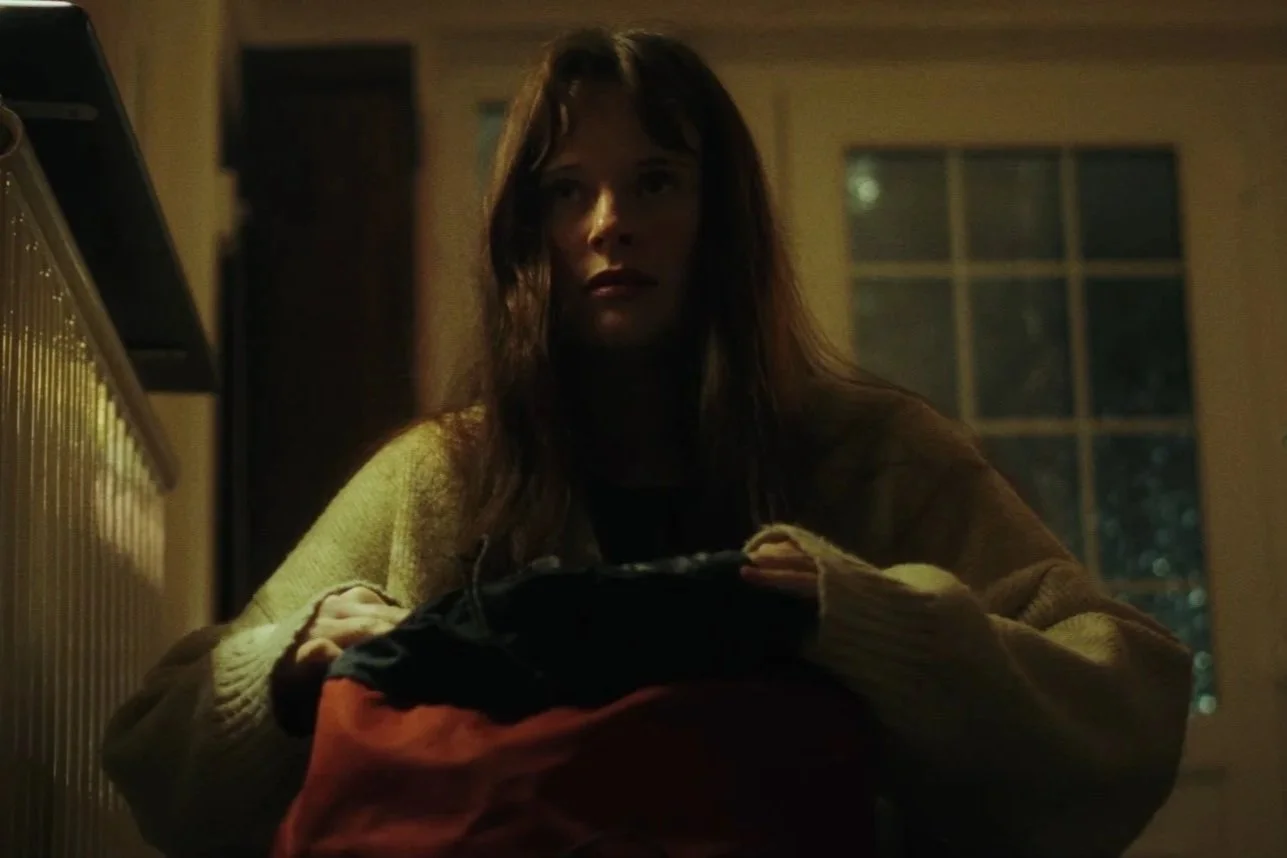
Courtesy of Zack Snyder & Fra Fee via Instagram.
Edward A. Palmer’s 'Visceral Images' understands that anxiety rarely arrives with the courtesy of announcing itself. Instead, it accumulates in awkward silences, unanswered messages, overstretched relationships and the unsettling feeling that everyone else in the room knows something you don’t. The film, debuting at the Manchester Film Festival, shows Palmer turning contemporary social unease into the foundation for a tense psychological thriller.
Imogen King stars as Freya, a young woman already carrying heaps of emotional weight. Much of her attention is consumed by concern for her troubled sister Clem, while her relationships with those around her offer little in the way of stability. When her friend Violet arrives at Freya’s home alongside her new boyfriend Zach (and considerably more company than Freya anticipated) the evening quickly begins to drift beyond her control.
Palmer is particularly interested in that loss of control. 'Visceral Images' is less concerned with frightening its audience than it is with placing us inside Freya’s increasingly unstable perception of the night. Seemingly ordinary social interactions now take on a threatening quality.
Palmer uses Freya’s experience to probe a generation navigating constant connectivity while somehow becoming increasingly isolated. Technology, environmental anxiety, emotional burnout and damaged human relationships all hover around the film without turning it into a beating-over-the-head lecture. These ideas are rarely presented as arguments, and largely exist as part of the characters’ psychological landscape.
That approach works largely because King gives the film such a convincing centre. Her performance is admirably restrained. Freya could easily have become a collection of nervous mannerisms, but King instead plays her anxiety as something internalised. A glance held slightly too long or a hesitation before speaking often communicates more than a dramatic outburst would. As the pressure surrounding her intensifies, King allows Freya’s fear to build incrementally, making the film’s eventual escalation considerably more effective.
Jemma Carlton provides a useful counterweight as Violet, bringing a looser, more impulsive energy into Freya’s carefully contained world. The wider ensemble similarly benefits the film, with the various personalities gathering inside the house transforming into competing psychological pressures. Adam Long, Vishnu Krishnan, Cathy Sole and Beca Barton each help give what could have been a conventional confined thriller a surprisingly textured social dynamic.
Much of 'Visceral Images' unfolds within an ordinary home, and the direction rarely allows the location to feel static. The camera frequently remains close to Freya, restricting both her awareness and ours. Characters disappear beyond frames and conversations occur just outside her immediate understanding.
The pacing may test viewers expecting a more traditional thriller, with Palmer spending a considerable amount of time allowing discomfort to develop. Rather than rushing toward revelations, 'Visceral Images' allows suspicion to ferment.
When the film finally releases that accumulated tension, the effect is substantial. Its closing movement transforms much of the preceding social awkwardness into something volatile, while still remaining consistent with the character study at its centre.
'Visceral Images' is a film about people surrounded by communication while struggling to understand one another. It’s occasionally rough around the edges, but there is confidence beneath that roughness. Anchored by an excellent Imogen King and strengthened by a lively ensemble, 'Visceral Images' turns one uncomfortable evening into an intelligent, claustrophobic study of anxiety, alienation and modern social pressures.
Our score (out of 5 stars): ★★★★☆