Antoine Fuqua’s ‘Michael’ is a Shiny, Shallow Portrait of a Complicated Star
Courtesy of Lionsgate.
Antoine Fuqua’s ‘Michael’ arrives as a polished, high-gloss music biopic that is never less than watchable, but rarely becomes illuminating. Like many films in the genre, it relies heavily on familiar conventions: the astonished producers in the studio, the brisk rise-to-fame montage, the battles with record executives, the tour-bus transitions, the neatly packaged moments of inspiration behind famous songs. In another era, these devices might have felt merely conventional; after Walk Hard, they can also seem unintentionally comic. ‘Michael’ is not unusual for using biopic shorthand, but it is notable for how completely it depends on it.
The film moves quickly through Jackson’s life, beginning with the Jackson 5 in Gary, Indiana, under the tyrannical rule of Joseph Jackson, and ending with the 1988 Wembley Stadium concert, when Michael is still only 30. That endpoint is striking, because the film closes not with resolution but with the vague promise that “The story continues.” It does, of course, and that is precisely the problem. By stopping where it does, the film avoids the most difficult, controversial, and psychologically revealing parts of Jackson’s life. What remains is less a full portrait than a carefully managed first half: the story of a prodigy, a victim, and a superstar, presented without much appetite for complication.
This selectiveness shapes the film’s entire method. ‘Michael’ includes the exotic pets, the Peter Pan imagery, the mounting fame, the cosmetic surgery, the Pepsi burn, the immense cultural breakthroughs, and the obsessive perfectionism. But it keeps circling the central questions rather than confronting them. The film acknowledges Jackson’s childhood abuse, yet hesitates to explore its consequences with any seriousness. It gestures toward his isolation, his arrested innocence, and his longing for emotional connection, but these remain broad traits rather than subjects of inquiry. The “elephant in the room” is not simply omitted; it is displaced by spectacle.
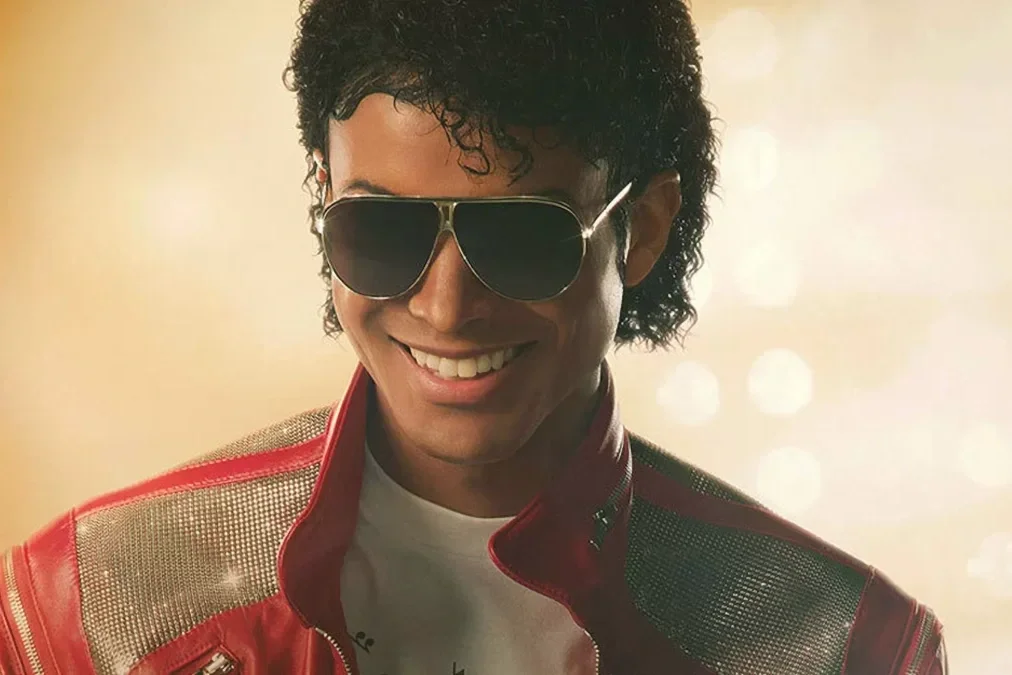
Jaafar Jackson, Michael’s nephew, gives the film its strongest reason to exist. His performance captures Michael’s physical vocabulary with impressive precision and intuitive flair, especially in the dance and performance sequences. He does not merely imitate the gestures; he recreates their rhythm and charisma well enough that the musical numbers often generate real excitement. Juliano Valdi is also effective as the younger Michael, especially in the opening scenes that establish both the child’s talent and the cruelty of his environment. The film is at its most alive when it allows performance itself to take over, because Jackson’s music still has the power to electrify almost any scene.
Yet the distinction between performing Michael and understanding Michael remains crucial, and the film never quite bridges it. Offstage, this version of Jackson is presented with a kind of endlessly gentle vagueness: soft-spoken, wounded, whimsical, forever smiling sadly at animals, storybooks, and memories of childhood. That may capture something real about his cultivated public persona, but the screenplay offers little sense of the inner tensions that might connect the shy, meticulous young star to the more perplexing figure he later became. The result is not exactly false, but dramatically inert. It gives us mannerisms without much interiority.
Colman Domingo, meanwhile, brings force to the role of Joseph Jackson, perhaps because he is the one character the film feels comfortable treating with moral clarity. His Joseph is brutal, exploitative, and sharply watchable. Nia Long has much less to do as Katherine Jackson, whose role is mostly confined to dignified sorrow and occasional resistance. The rest of the family and supporting cast are sketched thinly, often reduced to functional placeholders in Michael’s ascent. Quincy Jones, a monumental figure in Jackson’s career, feels oddly underwritten, while the prominence given to figures like bodyguard Bill Bray and attorney John Branca suggests the film’s priorities are not always dramatic ones. Mike Myers, in a cameo as Walter Yetnikoff, injects a little badly needed mischief, but the script remains too reverent to let supporting players disrupt its tone for long.
That reverence is the film’s defining limitation. John Logan’s script and Fuqua’s direction reconstruct famous moments efficiently, sometimes enjoyably, but seldom interpret them. The making of “Thriller,” the fight for MTV airplay, the development of iconic looks and choreography, the rise from child star to solo phenomenon — all are included, yet mostly as checklist items. Even Michael’s songwriting process is reduced to fragments, as if genius were a series of visual cues on a bulletin board. There is little sense of creative labor, risk, experimentation, or contradiction. The film reenacts achievements rather than dramatizing how they emerged.
This is especially frustrating because Jackson’s life is not short on material that would reward a more focused approach. Rather than trying to include everything from Gary to Wembley in two hours, the film might have chosen a narrower framework: the making of Thriller, the break from his father, the cost of child stardom, the remaking of Black pop stardom on MTV. Any one of these could have produced a richer and more coherent film. Instead, ‘Michael’ adopts the maximalist sweep of the cradle-to-superstardom biopic while remaining curiously afraid of conflict, ambiguity, and interpretation.
To be fair, the film is not without pleasures. The songs still land. The costumes and period details are often sharp. Some sequences — especially those tied to performance and choreography — have genuine momentum. For viewers unfamiliar with Jackson’s career, the film may function as a smooth introductory narrative. For fans, it may feel more like a glossy reenactment of material they already know. In either case, what lingers is less the drama than the soundtrack.
‘Michael’ feels less like a fully realized film than a prestige-approved act of image management: handsomely mounted, energetically performed, and ultimately too cautious to say much. It is not incompetent, and it is not dull in any total sense, because Michael Jackson’s music and stagecraft are too compelling for that. But it is shallow where it should be probing, schematic where it should be interpretive, and reverential where it most needs nerve. The brief “Thriller” material has more energy and authenticity than much of the larger film around it. As a portrait of an artist, ‘Michael’ is smooth, consumable, and frustratingly incurious. As a soundtrack delivery system, it works pretty well.
Our score: ★★★☆☆