‘Project Hail Mary’ Is a Sci-Fi Spectacle Where Intelligence Becomes the Ultimate Superpower
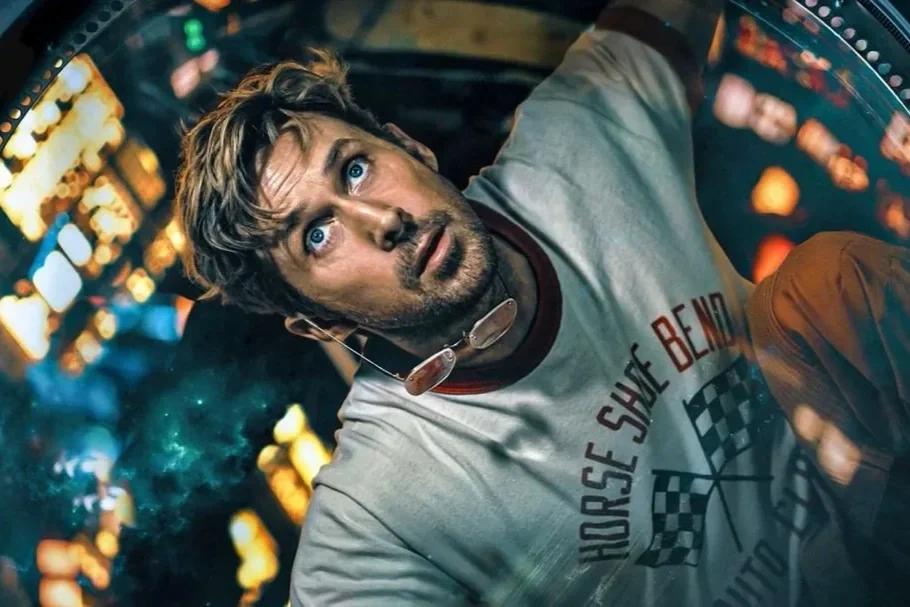
Courtesy of Amazon MGM Studios.
‘Project Hail Mary’ arrives as a glossy, big-budget meditation on the idea that intellect (rather than weaponry) may yet prove humanity’s most reliable survival strategy. At over two and a half hours, the film might sound like a marathon (to some) of astrophysical exposition. But the thoughtful feature moves with a surprising buoyancy, floating along with the exhilarating momentum.
Science-fiction cinema has long favoured the heroic choreography of lasers, blasters, and swords. From the original ‘Star Wars’ trilogy to the modern ‘Dune’ films, the genre’s climactic question often boils down to martial competence: who can shoot straighter, swing harder, detonate faster, or simply out-smart each other. Yet a smaller, more cerebral lineage of sci-fi blockbusters exists: one where equations trump explosions. Ridley Scott’s ‘The Martian’ (2015) and Denis Villeneuve’s ‘Arrival’ (2016) stand as a modern exemplars.
Adapted from Andy Weir’s novel by Drew Goddard, it framed survival not as combat but as applied problem-solving. Now Goddard returns to Weir’s universe with ‘Project Hail Mary,’ another tale in which salvation depends less on brute force than on the patient triumph of scientific reasoning.
This time the directorial helm belongs to Phil Lord and Christopher Miller, whose sensibilities lean toward bright, irreverent spectacle. Their previous triumph, ‘The Lego Movie,’ practically canonised the philosophy that “Everything Is Awesome,” and that cheerful ethos permeates this film as well. Casting Ryan Gosling (a performer who seems constitutionally incapable of suppressing his goofy charisma) ensures that even an extinction-level crisis acquires a certain playful sparkle.
Gosling plays Ryland Grace, who awakens aboard a cavernous spacecraft hurtling toward a distant star system. The situation is less than ideal: his two crewmates have perished, and several years of medically induced sleep have scrambled his memory. As his recollections gradually reassemble themselves, Grace remembers that he is a biologist drafted (by the wonderfully deadpan Sandra Hüller) into the emergency initiative known as Project Hail Mary.
The threat facing Earth is not an invading fleet but an ecological catastrophe on a cosmic scale. Alien microbes dubbed “Astrophages” are devouring the Sun’s radiation, slowly dimming the star and threatening to plunge Earth into an irreversible deep freeze. Grace’s assignment is elegantly desperate: travel to the one nearby star mysteriously untouched by the Astrophages, determine why it remains immune, and transmit the solution back home, even if the mission itself is strictly one-way.
But Grace is not entirely alone. Another spacecraft pursuing the same investigation arrives from an entirely different civilization. Its sole survivor is Rocky, an entirely loveable crab-like extraterrestrial composed of rocky nodules — realised through a mix of puppetry and digital enhancement. The genial alien constructs a passageway between the ships, and the two gradually develop a method of communication via Grace’s computer, which translates Rocky’s melodic, R2-D2-esque chirps into English. Compared with the linguistic puzzles of Arrival, interstellar diplomacy here unfolds with charming efficiency.
Obstacles tend to dissolve almost as soon as they appear. Grace confronts each new problem — whether biological, mechanical, or astrophysical — with brisk competence, which occasionally sacrifices dramatic tension for breezy momentum. This results in ‘Project Hail Mary’ evolving into an interstellar buddy comedy. Grace, notably unattached to family or romance, carries none of the aching personal stakes that fueled has fueled a majority of interstellar sci-fi films. The apocalypse, it seems, can be met with a shrug and a well-timed quip.
And yet the film’s lightness may be precisely its secret weapon. Lord and Miller have constructed an enormous sci-fi spectacle that is, for long stretches, essentially a one-man show built from scientific puzzles rather than action set pieces. Instead of laser battles, the narrative revolves around experimental trials, theoretical leaps, and increasingly elaborate problem-solving. Sustaining momentum under such constraints is no small achievement and the film accomplishes it with remarkable verve.
The visuals are striking, and perhaps the film’s strongest leg. Cinematographer Greig Fraser comes off the success of Matt Reeves’ ‘The Batman’ and Villeneuve’s ‘Dune’ films, proving yet again that his imagination and technical flair has no limits. Though not has breath-taking has some of his previous works, with bursts of radiant color and ultra-wides designed to engulf every cerebral fibre for maximal impact, Fraser has hit another home-run.
For all its playfulness, ‘Project Hail Mary’ carries a quietly radical thesis. Humanity’s survival, it suggests, will not hinge on superior firepower but on curiosity, cooperation, and the shared pursuit of knowledge, even across species and galaxies. In an era when blockbuster heroism so often arrives armed to the teeth, that proposition feels almost subversive.
This is a film designed to be seen on the largest IMAX screen possible. Pure, unfiltered escapism.
‘Project Hail Mary’ score: ★★★★☆